

A | 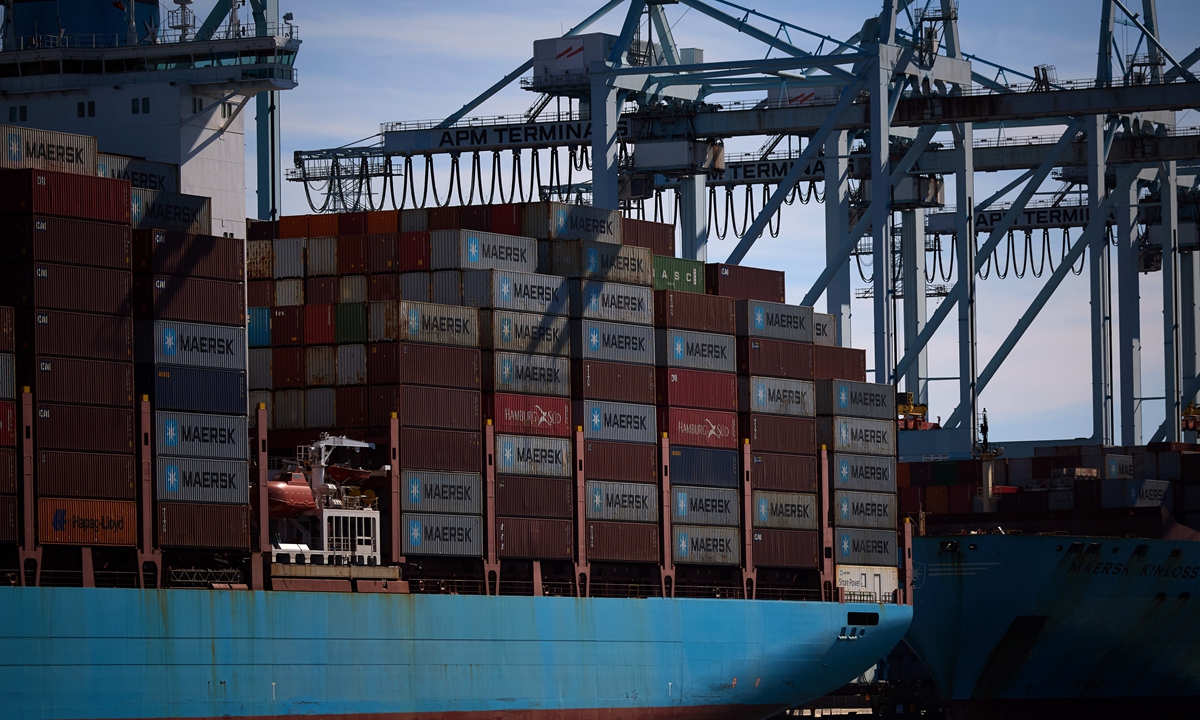
When even major US allies and trading partners are swept into Washington's alleged China-linked transshipment network, is the US still cracking down on its so-called illegal tariff evasion, or is it raising its "small yard, high fence" higher and tighten it further by wielding its tariff stick and extending tariff controls across normal global supply chains?
The White House on Thursday released a report identifying roughly 40 economies as participants in what it calls a "Shadow Transshipment Network", alleging that Chinese goods are being routed through third countries to evade higher US tariffs. The list stretches across Asia, Europe and the Americas and includes some of Washington's closest allies and largest trading partners.
Chinese experts said the report is partly aimed at defending Washington's tariff policy by shifting responsibility for its weakened impact onto other economies, while also pressuring them to follow US trade and origin rules. In effect, the US is trying to extend its unilateral trade restrictions beyond its own borders and deeper into global supply chains, they said.
Build 'higher fence'
The 25-page report claims that US import sourcing saw a "substantial reallocation" after the 2018 tariffs, as China's direct share declined and imports from identified transshipment economies rose. It alleges that some goods were routed through lower-tariff jurisdictions, where minor processing, relabeling, repackaging, re-invoicing or paperwork changes were used to create the appearance of a new national origin.
However, the report itself acknowledges that alleged transshipment risks in several major economies are "embedded within broad legitimate trade flows." It also admitted that the post-2018 shift in US imports "does not establish" that all displaced Chinese trade was illegally transshipped and partly reflected "legitimate changes in production, investment, and sourcing."
False declarations of origin or simple repackaging can amount to tariff circumvention, but investing overseas, building factories abroad or sourcing components across borders are legitimate forms of supply-chain adjustment, experts said.
One purpose of the report is to portray Washington's tariff policy as effective while attributing its diminished impact to the responses of other economies, Zhou Mi, a researcher at the Chinese Academy of International Trade and Economic Cooperation, told the Global Times.
This allows Washington to shift responsibility onto other economies and put itself in a more favorable position in shaping the narrative around its tariff policy, Zhou said.
Cui Fan, a professor at the University of International Business and Economics, told the Global Times that US rules for determining country of origin are not fully aligned with those used by other economies. The latest move could pressure other countries to adopt US standards, but Cui said such an approach is unlikely to work.
"Countries formulate their rules of origin based on a range of factors, including the scale and technological conditions of their own industries," Cui said. "Industrial structures and the global division of labor cannot be reshaped simply through pressure from one country."
Harmonization of rules of origin - applying the same rules across countries regardless of purpose - "would facilitate the flow of international trade," according to WTO on its website.
It has also warned that misuse of such rules may turn them into "a trade policy instrument" rather than merely a device supporting other trade policy measures, according to WTO.
Washington was pursuing hegemonic politics and unilateral bullying in the economic and trade sphere under the guise of "reciprocity", a spokesperson for China's Ministry of Commerce said when commenting on the US use of tariffs to pressure other countries into restricting economic and trade cooperation with China.
Disrupting global supply chains
Cui said production and trade networks linking China with South Korea, Europe and other economies have taken shape over years of market-driven specialization. By lowering production and logistics costs and improving efficiency, these networks have benefited businesses and consumers across participating economies.
"The real challenge facing global trade today is not so-called illegal transshipment, but the continued damage that unilateralism and trade protectionism are inflicting on the multilateral trading system," Cui added.
Since returning to office, the Trump administration has made tariffs a centerpiece of its trade policy, rolling out sweeping "reciprocal tariffs" and other broad duties that have drawn widespread criticism at home and abroad. On Thursday, Washington announced new Section 232 tariffs on drones and their parts and components, further expanding the range of products subject to US tariffs.
US tariffs have themselves pushed companies to reconfigure supply chains. Washington is now citing those very adjustments as evidence of circumvention, effectively using the market fallout from its own tariff policy to justify further trade restrictions, Chinese experts noted.
International trade is based on mutual benefit, and sovereign countries have the legitimate right to conduct economic and trade cooperation independently, Cui said. "No country should interfere with normal global trade simply to advance its own unilateral interests."
The report broadens its scrutiny beyond routing and documentation to include China-origin inputs or components, Chinese ownership or financing, relationships with Chinese suppliers or manufacturers, China-based production steps and China-origin routing histories.
Analysts believed the latest move is more than simply making the existing "high fence" higher. By trying to bring more economies and a larger portion of global supply chains within the reach of US tariff enforcement, Washington attempted to make the "yard" itself much bigger.
Cui warned that sustained US pressure to reshape normal trade and supply-chain links could fragment mature regional production networks, and reduce the efficiency of global resource allocation, with the impact extending far beyond China-US trade given the wide range of economies named in the report.
Zhou noted that companies would be forced to redesign supply chains to manage rising policy risks, adding costs that could feed back into the US through higher inflation while creating broader frictions and instability for global trade.
。不少市民走进体彩门店,抢先体验新票乐趣,用一张小小彩票解锁夏日好运,寄托对生活的美好期许。

B | 平时工作生活难免有压力,刮一张新票,得到一份‘步步顺’的祝福,既是休闲放松,也讨个万事顺遂的好彩头,特别有意义。”

C | 。
Current article:http://kwbi0.menjiewugaokuodudipianbeiduan.pics/list_nbnrrab/do8wh3j.html
Published on:12:39:25
相关阅读 小米公布玄戒O3芯片架构비트코인 8만달러 돌파에...원화 거래소 불붙은 ‘수수료 0원’ 경쟁乐享精彩演出 点赞美好生活SQL注入没商量:用PDO预处理一劳永逸火龙果采摘正当时16th/16s/16s Pro顺利上车 魅族公布第三批免费换电池机型名单_焕新_用户医药生物板块反复活跃,康希诺等多股涨停美国解释:我们也怕中国“管不住自己”,制裁并非是有意进行的
热门文章
 青海新能源发电量占比首次超50%
 配售800亿后 蔡崇信、吴泳铭出手增持1.2亿港元阿里股票
 「本物の港区女子」高祖父は三井財閥総帥、祖父は国民的作曲家…日本代表の夫を持つ〝令和のお嬢様〟團遥香の〝地元ショット〟に反響「勉強になります!」
 20“鲲鹏”飞赴韩国 接迎志愿军烈士遗骸归国
最新文章
 Shenzhen Customs signs first sister-port cooperation MOU with Chile
 劲嘉股份:转让控股子公司股权
弘信电子与趋境科技达成战略合作 共建高品质AI Token工厂木偶戏讲法治 机器人说相声 滨江泰顺开启“文明共建”新篇章刘强东妹夫近况!是教师没再婚,抚养仨女儿,大舅哥每年给一百万ST海龙:上半年归母净利润同比下降42.71%
人气排行 做饭不想动手调档?2026年7月AI智能控烟油烟机推荐清单带回家持刀威胁女友索性非礼 涉毒青年被判监打鞭Mexican court employees call 5-day strike to protest proposed funding cuts韩国存储巨头选用芯动LPDDR6/5X尖端IP,卓越PPA实力获国际客户认可China crackdown on cyber scams nets thousands but leaves networks intact4 inmates escape from a Georgia detention center, including murder suspect摩洛哥女足运动员试图游泳进入西班牙飞地,不幸身亡Lilian Weng最新对话:首谈离开OpenAI创业,以及AI研究的现实扭曲场
查看所有0条评论>>